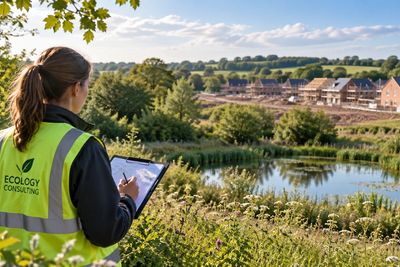
Preliminary Ecological Appraisal
A Guide for Planning and Development
A Preliminary Ecological Appraisal (PEA) is often one of the first steps in understanding the environmental considerations associated with a proposed development. Whether you're planning a residential scheme, commercial project or infrastructure development, identifying ecological constraints early can help prevent delays and support responsible decision-making.
At Ecology Consulting Ltd, we provide professional preliminary ecological assessment services for developers, architects, landowners and planning professionals throughout the UK. Our experienced ecologists identify potential ecological risks, recommend appropriate surveys and provide practical guidance to help projects progress.
What Is a Preliminary Ecological Appraisal?
A Preliminary Ecological Appraisal is an initial assessment of a site's habitats, wildlife potential and ecological features.
Its purpose is to identify ecological constraints and opportunities before development plans are finalised.
The appraisal typically combines a desk study with an on-site habitat survey, allowing ecologists to evaluate the site's existing ecological characteristics.
A PEA can highlight habitats of conservation importance, potential protected species activity and areas where development could cause ecological impacts.
The findings help determine whether additional surveys, mitigation measures or design changes may be necessary.
Although the terms Preliminary Ecological Appraisal and Preliminary Ecological Assessment are frequently used interchangeably, PEA is the recognised term used in professional ecological guidance.
When Is a Preliminary Ecological Assessment Required?
A preliminary ecological assessment may be requested when a proposed development could affect habitats, protected species or other ecological features.
Common projects requiring ecological consideration include housing developments, commercial construction, agricultural diversification, infrastructure works and renewable energy installations.
Even relatively small developments can have ecological implications, particularly where buildings, mature trees, hedgerows or watercourses are present.
Local planning authorities may require ecological information to assess whether a proposal complies with relevant environmental legislation and planning policies.
Not every project requires a PEA, but obtaining professional advice early can help establish the appropriate level of assessment.
What Does a Preliminary Ecological Appraisal Include?
A professional PEA generally involves several stages designed to establish an initial ecological understanding of the development site.
Ecological Desk Study
The desk study reviews existing environmental information relevant to the site and surrounding area.
This may include designated wildlife sites, biological records, aerial photography and existing habitat information.
The findings provide important context and help identify ecological features that require closer examination during the site visit.
Habitat Survey and Site Inspection
An experienced ecologist visits the site to identify and map habitats using an appropriate recognised survey methodology.
Features such as grassland, woodland, hedgerows, ponds, buildings and watercourses are assessed for their ecological value and potential to support wildlife.
The survey also records evidence of protected species where present, although a PEA is not a substitute for detailed species-specific surveys.
Ecological Constraints and Recommendations
Following the assessment, the ecologist prepares a report outlining the findings and recommended next steps.
This may identify opportunities to retain valuable habitats, avoid sensitive areas or incorporate biodiversity enhancements into the development design.
Where necessary, the report recommends further surveys or specialist ecological assessments.
A preliminary ecological appraisal helps identify whether habitats or structures could support legally protected species.
Depending on the site, further investigations may be recommended for bats, great crested newts, badgers, reptiles, breeding birds, otters or water voles.
For example, mature trees and buildings may provide suitable bat roosting features, while ponds and surrounding terrestrial habitats may require assessment for great crested newts.
Some protected species surveys can only be completed during particular seasons.
Identifying these requirements early is important because missing a suitable survey window could delay planning submissions or construction programmes.
At Ecology Consulting Ltd, our team provides specialist protected species surveys and licensing support where required.
Ecological information helps planning authorities understand the potential environmental effects of proposed development.
A PEA can demonstrate that ecological constraints have been considered and identify where additional evidence is needed.
Its recommendations may influence site layout, construction methods, habitat retention or proposed landscaping.
However, a PEA does not automatically guarantee planning permission, and further ecological information may be necessary before an application can be determined.
For projects with potentially significant ecological effects, a more detailed Ecological Impact Assessment (EcIA) may be appropriate.
Our consultants work with project teams to provide proportionate ecological advice that supports informed planning decisions.
A Preliminary Ecological Appraisal and Biodiversity Net Gain (BNG) assessment serve different but related purposes.
A PEA identifies ecological features, constraints and opportunities, while a BNG assessment calculates habitat biodiversity value and evaluates proposed losses and gains.
In England, mandatory Biodiversity Net Gain generally requires applicable developments to deliver at least a 10% increase in biodiversity value, subject to relevant exemptions and transitional arrangements.
A PEA can help establish whether more detailed habitat surveys and biodiversity calculations are needed.
At Ecology Consulting Ltd, we provide both preliminary ecological assessments and BNG services, helping clients coordinate environmental requirements throughout the planning process.
How Long Does a Preliminary Ecological Appraisal Take?
The time required depends on the site's size, accessibility, habitat complexity and availability of background ecological information.
The initial site visit may be completed relatively quickly for a straightforward property, while larger or more complex sites require additional survey effort.
Report preparation and consultation requirements can also influence overall timescales.
Although preliminary habitat assessments can often be undertaken throughout the year, seasonal conditions may affect the information available.
Where further protected species surveys are necessary, these may introduce additional scheduling requirements.
Commissioning ecological work during the early design stages gives project teams more flexibility.
Why Choose Ecology Consulting Ltd?
At Ecology Consulting Ltd, we combine professional ecological expertise with a practical understanding of development and construction requirements.
Our team includes Chartered Ecologists and Chartered Environmentalists, with experience supporting residential, commercial, infrastructure and renewable energy projects.
We provide Preliminary Ecological Appraisals, protected species surveys, Ecological Impact Assessments, Biodiversity Net Gain assessments and ecological mitigation advice.
Our approach focuses on clear reporting, early identification of constraints and realistic recommendations tailored to each development.
By working closely with developers, architects and planning professionals, we help balance project objectives with environmental responsibilities.
Arrange a Preliminary Ecological Appraisal Today
Understanding your site's ecological requirements early can make the planning process more manageable and reduce the risk of avoidable delays.
At Ecology Consulting Ltd, we provide professional preliminary ecological appraisal and preliminary ecological assessment services throughout the UK, supported by experienced consultants and practical planning advice.
Whether you're preparing a planning application or exploring a potential development opportunity, our team can help establish the ecological information your project requires.
Contact us today to discuss your site, request a quotation and arrange a Preliminary Ecological Appraisal tailored to your development.